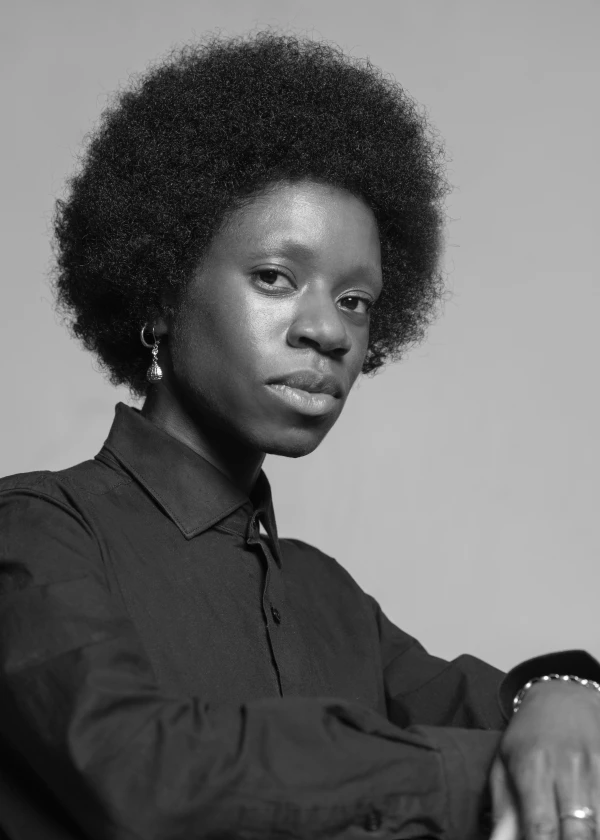
Fanny Howe was born on 15 October 1940 in Buffalo, New York. She is the author of more than fifty books of poetry and prose, and taught literature and writing throughout her life, mentoring a generation of American poets, activists and scholars working at the intersection of experimental and metaphysical thinking. She was professor emerita in literature at the University of California, San Diego, until her death on 8 July 2025 in Lincoln, Massachusetts.
This Poor Book
£ 11.99
This Poor Book
Fanny Howe
Fanny Howe is a titan. Absolutely nobody writes like her. Nobody sounds like her. This Poor Book is a miracle she left for us.
This Poor Book is revelatory and casts Howe’s poetry in a new light, and for those who don’t know her work already, this is a perfect introduction. Fanny Howe is an essential poet.
Fanny Howe spoke about “the difficulty of reconciling multiple registers of consciousness and language. Soul and sticky atoms.” In This Poor Book she delineates and shifts between these layers to conjure a bewildering yet ultimately galvanizing evocation of the human psyche. We are being warned every day that robots and software will soon replace us. Howe’s poetry makes clear that such a notion is based upon a very limited conception of what it is to be a human. We are complex. We are mysterious. We don’t make sense. We do make sense. You will lose and you will find yourself in her words.
This Poor Book is a testament to Fanny Howe’s life and writing. In it, she wields her powers of perception for a long poem that turns inward on the self and out at the world and in every other direction the poet can imagine with lines that speak directly and always suggest more than they say: “There is a little trouble in my eye.” The irony and beauty of its final line—“There was no more reason to die”—will be with me for as long as my memory of Fanny Howe herself.
Fanny Howe is the closest thing we have to a sage to guide us through turbulent times, a poet who reminds us that the personal is political and that the political is about people. Her craft, wisdom and force of will are models for how to live, and how to write.
In her final act of literary alchemy, Fanny Howe gathers the scattered constellations of her astonishing life work and forges them into a single unwavering spiritual reckoning. At the dynamic center of the poem, a live beating heart moves through a fractured world—haunted by power, estranged from institutions, yet fiercely open to mystery. There’s a radical humility here, paired with a radiant understanding—that doubt can be a form of faith, and that hope, when unflinching, is the most defiant music of all. This Poor Book is for the ages.
This Poor Book is an astonishing swan song, a travelogue between worlds, a poet’s version of settling a legacy, and a mystic’s gesture toward a future inheritance for the seekers to come.
This Poor Book is an astonishing document by an irreplaceable poet. A palimpsest of decades’ worth of writing, assembled here into a long poem as fractured and multitudinous as life itself, Fanny Howe’s last work captures the brutality and beauty of the modern world better than almost anything else I’ve read: “The structure failed to cohere at the end of the struggle. / It had some music in it.”
Through Fanny Howe's eyes we look at life differently. She makes us understand that we are part of a mysterious and complex world; one which we urgently need to be receptive to. Beauty appears in unexpectedness, as in “flowers attract scissors” and “why does an eye evolve in the dark?” Who else could turn things upside down with such a sleight of hand? This Poor Book reads like the testament of a newly discovered life-form, offering vital messages from the past and into the future.
At once evocative and subtly incisive Howe’s writing seems almost like a new language, a language that has been in hiding. She can make the familiar haunting and the ordinary a provocation.
This gorgeous final statement by one of our most perceptual writers is a work of accrued understanding. ... Fanny Howe leaves us with profound investigations into the capacity of words, of juxtaposition, what a line, a page, and a book can give.
For decades, Fanny Howe has been the great poet of spirit and conscience, dislocation and bewilderment. In This Poor Book, completed just before her death, she assembled a selection of her writing from the last thirty years into a single, astonishing work.
- 978-1-0684395-5-1
- 19.8 x 12.8 cm
- 144 pp.
- Paperback
- 05 May 2026
About the author
Press (7)
This Poor Book: A Poem by Fanny Howe – a radical final act by an extraordinary Irish-AmericanThe Irish Times2030/05/2026
Upcoming (2)
| 21 September | Edinburgh | Fanny Howe films at Embassy Gallery |
| 10 October | Christchurch | Fanny Howe films at Te Puna o Waiwhetū Christchurch Art Gallery |


Another Sun
£ 11.99
Another Sun
Françoise Vergès Mayra A. Rodríguez Castro
In 2005, Françoise Vergès published a book with Aimé Césaire, in which she recorded – three years before his death – powerful remarks by the poet, as incisive and combative as ever, yet imbued, as always, with the universal humanism to which he had remained committed throughout his life. It is fortunate that, drawing inspiration from this interview, Another Sun allows us to hear, in their intertwining, the voices of Césaire and Vergès herself, conveying a message of emancipation and fraternity/sorority that our world needs to hear today.
Waiting at Martinique Aimé Césaire International Airport, in the city of Le Lamentin, Mayra A. Rodríguez Castro browses the airport kiosk. Alongside books by Césaire, it offers titles by Frantz Fanon, Maryse Condé and Patrick Chamoiseau. She picks up a copy of Nègre je suis, nègre je resterai, a conversation between Françoise Vergès and Césaire published in 2005, and embarks. In Another Sun, Rodríguez Castro and Vergès revisit that seminal conversation, resulting in an eclectic text shaped by ongoing struggles.
With poems by Danielle Legros Georges, Wole Soyinka, Ishion Hutchinson, Clarisse Baleja Saïdi, Aimé Césaire and Jean Érian Samson.
- 978-1-0684395-2-0
- 21.6 x 13.9 cm
- 100 pp.
- Paperback
- 04 June 2026
About the authors (2)
Françoise Vergès is a writer, decolonial anti-racist feminist and curator. She is currently working on the fabrication of premature death, imperialism and anti-imperialism, the colonial roots of fascism, private property and racism. In parallel, she is working on a film about communist anti-colonial struggles on Réunion and in the Southwest Indian Ocean based on her parents’ personal archives and her own. Her recent publications include: Making the World Clean: Wasted Lives, Wasted Environment, and Racial Capitalism (2024); A Programme of Absolute Disorder: Decolonizing the Museum (2024); A Decolonial Feminism (2021); The Wombs of Women: Race, Capital, Feminism (2020); and Resolutely Black: Conversations with Françoise Vergès, with Aimé Césaire (2019). She has written documentary fifilms on Maryse Condé and Aimé Césaire (both 2013) and was a project advisor for Documenta11 (2002) and La Triennale de Paris (2012). Vergès is currently senior research fellow at the Sarah Parker Remond Centre for the Study of Racism and Racialisation, University College London.
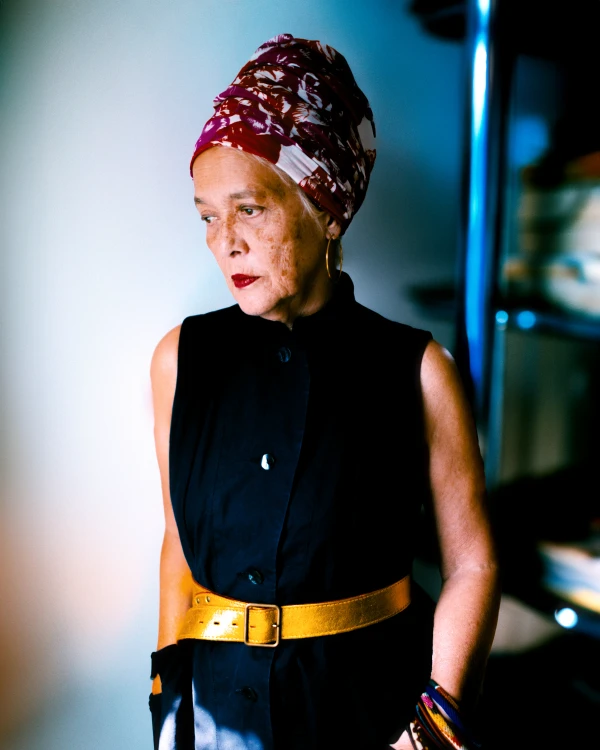
Mayra A. Rodríguez Castro is a writer and editor. She was a postdoctoral fellow at Freie Universität Berlin in 2018, recipient of a fellowship with Anne Waldman at Naropa University in 2019, and a textual residency fellow at Akademie Schloss Solitude in 2025. Her essay ‘El nuevo sublime’ was a finalist for the National Essay and Criticism Award in Colombia in 2019. Rodríguez Castro is the editor of Dream of Europe: Selected Seminars and Interviews, 1984–1992 (2020), a collection of previously unpublished lectures by Audre Lorde, which was shortlisted for the Pegasus Award for Poetry Criticism in 2021. She is also the author of The Echo (2025) and Blood (2026).