Divided Publishing

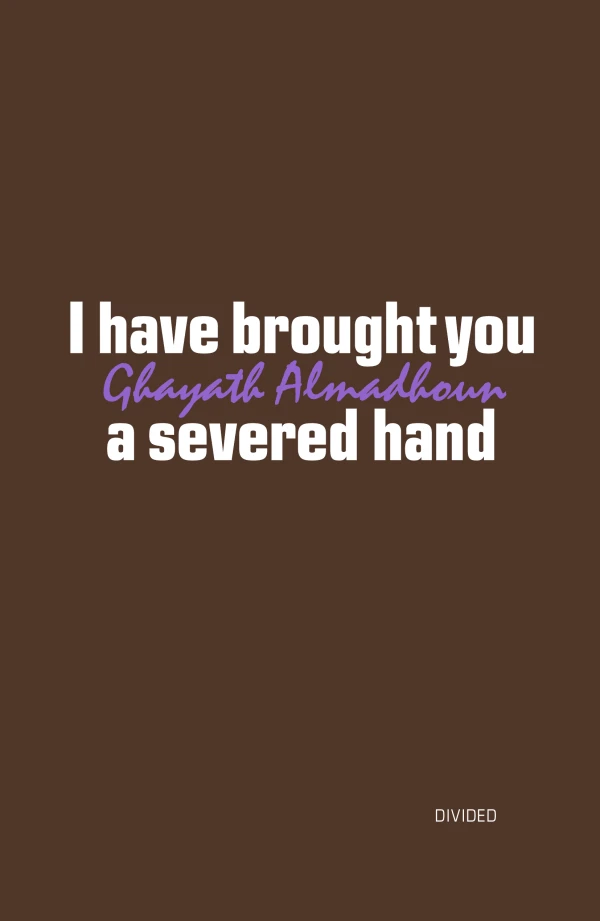
I have brought you a severed hand

£ 11.99
£ 11.99

I have brought you a severed handGhayath Almadhountrans. Catherine Cobham

£ 11.99

I have brought you a severed hand

Ghayath Almadhoun

trans. Catherine Cobham

Fluid and unselfconscious, Ghayath Almadhoun writes love poems in the shape of nightmares: I have brought you a severed hand is a surreal mix of absurd humour, heteroerotic lust and dead seriousness. Caught between two exiles, the one inherited from his Palestinian father and the one he chose and lives, Almadhoun attempts to explain water and tame hope.

Finalist for the 2026 PEN Award for Poetry in Translation.

  • 978-1-7398431-2-0
  • 21.6 x 13.9 cm
  • 144 pp.
  • Paperback
  • 24 March 2025

About the author

Ghayath Almadhoun (born 1979, Damascus) is a Syrian-Palestinian poet who moved to Sweden in 2008. He has published five collections of poetry in Arabic, the latest being Adrenalin (Almutawassit, 2017) and I have brought you a severed hand (Almutawassit, 2024). In 2017, Adrenalin was translated into English by Catherine Cobham and published by Action Books. In 2023, Almadhoun curated, edited and translated the poetry anthology Kontinentaldrift: Das Arabische Europa (Verlag Das Wunderhorn and Haus für Poesie), which includes thirty-one Arabic poets living in Europe. The English translation of I have brought you a severed hand is published simultaneously by Divided in the UK and Europe and by Action Books in the USA. Almadhoun currently lives between Berlin and Stockholm. His work has been translated into nearly thirty languages.
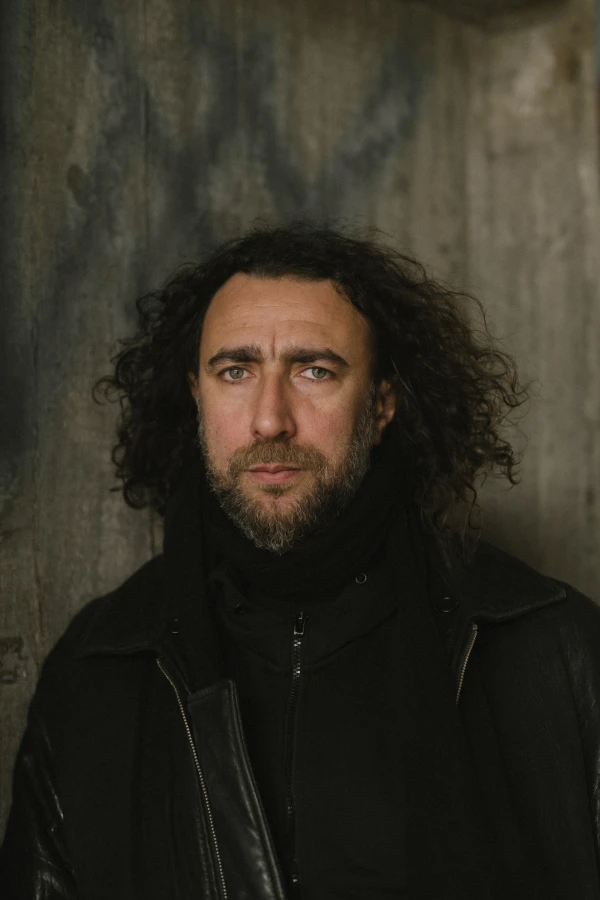

Photo: Sina Opalka

About the translator

Catherine Cobham taught Arabic language and literature at the University of St Andrews, Scotland, for many years and was head of the department of Arabic and Persian from 2011 until 2021. She has translated the work of a number of Arab writers, including poetry by Adonis, Mahmoud Darwish, Ghayath Almadhoun, Tammam Hunaidy and Nouri al-Jarrah, and novels and short stories by Yusuf Idris, Naguib Mahfouz, Hanan al-Shaykh, Fuad al-Takarli and Jamal Saeed. She has written articles in academic journals and co-written with Fabio Caiani The Iraqi Novel: Key Writers, Key Texts (Edinburgh University Press, 2013).

Endorsements (3)

This book never misses the defiant beat of an exile’s haunted footing across wars, seas and memory. Almadhoun turns the genocidal logic of colonialism upside down, emptying out the crumbs of humanity and civilisation.

Don Mee Choi

Almadhoun uses every possible means of silence to make the total devastation palpable.

Alfred Schaffer

Many poets attempt to traverse the gulf between the experience of tragedy and the ability to relay its magnitude to anyone else. But few living have done it with such flourish, such sustained passion and formal precision as Ghayath Almadhoun.

Kaveh Akbar

Press (7)

I have brought you a severed handGodelieve de BreeWasafiri, Issue 125, Spring 202614602/2026
Book of the Week: Ghayath Almadhoun, I have brought you a severed handPalFestPalestine Festival of Literature24/07/2025
Ghayath Almadhoun: Europe, we love your art and hate your bombsDritan KiçiThe Brussels Review24/05/2025
Ghayath Almadhoun: Writing is my real homelandDimitra DidangelouThe Brussels Review10/10/2024

Upcoming (2)

28 April Online Ghayath Almadhoun and Catherine Cobham at Push the Boat Out Poetry Festival
22 –⁠ 23 August Norway Møllebyen Litteraturfestival 2026

This Poor Book

£ 11.99
Pre order in Europe UK
£ 11.99
Pre order in Europe UK

This Poor BookFanny Howe

£ 11.99

This Poor Book

Fanny Howe

Fanny Howe is a titan. Absolutely nobody writes like her. Nobody sounds like her. This Poor Book is a miracle she left for us.

Kaveh Akbar

This Poor Book is revelatory and casts Howe’s poetry in a new light, and for those who don’t know her work already, this is a perfect introduction. Fanny Howe is an essential poet.

Rae Armantrout

Fanny Howe spoke about “the difficulty of reconciling multiple registers of consciousness and language. Soul and sticky atoms.” In This Poor Book she delineates and shifts between these layers to conjure a bewildering yet ultimately galvanizing evocation of the human psyche. We are being warned every day that robots and software will soon replace us. Howe’s poetry makes clear that such a notion is based upon a very limited conception of what it is to be a human. We are complex. We are mysterious. We don’t make sense. We do make sense. You will lose and you will find yourself in her words.

Claire-Louise Bennett

This Poor Book is a testament to Fanny Howe’s life and writing. In it, she wields her powers of perception for a long poem that turns inward on the self and out at the world and in every other direction the poet can imagine with lines that speak directly and always suggest more than they say: “There is a little trouble in my eye.” The irony and beauty of its final line—“There was no more reason to die”—will be with me for as long as my memory of Fanny Howe herself.

Jericho Brown

In her final act of literary alchemy, Fanny Howe gathers the scattered constellations of her astonishing life work and forges them into a single unwavering spiritual reckoning. At the dynamic center of the poem, a live beating heart moves through a fractured world—haunted by power, estranged from institutions, yet fiercely open to mystery. There’s a radical humility here, paired with a radiant understanding—that doubt can be a form of faith, and that hope, when unflinching, is the most defiant music of all. This Poor Book is for the ages.

Peter Gizzi

This Poor Book is an astonishing document by an irreplaceable poet. A palimpsest of decades’ worth of writing, assembled here into a long poem as fractured and multitudinous as life itself, Fanny Howe’s last work captures the brutality and beauty of the modern world better than almost anything else I’ve read: “The structure failed to cohere at the end of the struggle. / It had some music in it.”

Maggie Millner

Through Fanny Howe's eyes we look at life differently. She makes us understand that we are part of a mysterious and complex world; one which we urgently need to be receptive to. Beauty appears in unexpectedness, as in “flowers attract scissors” and “why does an eye evolve in the dark?” Who else could turn things upside down with such a sleight of hand? This Poor Book reads like the testament of a newly discovered life-form, offering vital messages from the past and into the future.

Celia Paul

At once evocative and subtly incisive Howe’s writing seems almost like a new language, a language that has been in hiding. She can make the familiar haunting and the ordinary a provocation.

Adam Phillips

This gorgeous final statement by one of our most perceptual writers is a work of accrued understanding. ... Fanny Howe leaves us with profound investigations into the capacity of words, of juxtaposition, what a line, a page, and a book can give.

Sarah Schulman

For decades, Fanny Howe has been the great poet of spirit and conscience, dislocation and bewilderment. In This Poor Book, completed just before her death, she assembled a selection of her writing from the last thirty years into a single, astonishing work.

  • 978-1-0684395-5-1
  • 19.8 x 12.8 cm
  • 144 pp.
  • Paperback
  • May 2026

About the author

Fanny Howe was born on 15 October 1940 in Buffalo, New York. She is the author of more than fifty books of poetry and prose, and taught literature and writing throughout her life, mentoring a generation of American poets, activists and scholars working at the intersection of experimental and metaphysical thinking. She was professor emerita in literature at the University of California, San Diego, until her death on 8 July 2025 in Lincoln, Massachusetts.

Press (1)

Lyric Risk: On Fanny HoweMisha HoncharenkoStill Point27/03/2026