Jackie Ess is a writer and teacher.

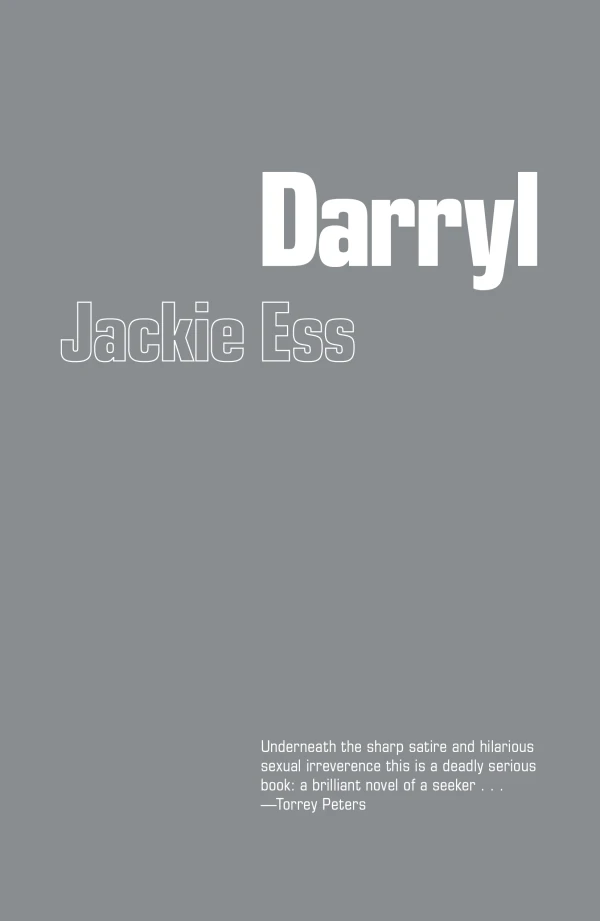
Underneath the sharp satire and hilarious sexual irreverence this is a deadly serious book: a brilliant novel of a seeker, like The Pilgrim’s Progress refracted by queer internet culture.
Darryl Cook is a cuckold, and that’s exactly how he likes it. He has an inheritance that spares him from work, a manageable and seemingly consequence-free drug habit, and a lovely wife called Mindy who’s generally game for anything—and for as much of it as she can get. But after an accidental overdose and some serious oversharing, Darryl’s world begins to crack up. Tormented by what seems to be the secret truth in sex, and less assured of that secret’s form, Darryl steps into what used to be called real life . . . Darryl is a disarmingly funny and unabashedly intelligent look at a community of people parsing masculinity, marriage, sex (and love) on their own terms.
Jackie Ess is a writer and teacher.
Running through it’s core is a torrent of wisdom at a fibre-optic pace with more power than even the most edited digital diatribe ... It’s a beautiful, genre-bending book — a jewel of the future that demands to be read, treasured, now.
Darryl crashes through the pieties of inclusive literature like a horny aurochs through an Apple Store. Jackie Ess’s vicious wit and humane soul refuse to settle for anything less than an enhanced interrogation of human frailty, here through the psychosexual evisceration of an ordinary, relatable guy who simply wants someone else to bang his wife. Who doesn’t? This book takes the raw power of the sentence seriously, which is the best way to be funny: Darryl is sprinting ahead of the reader, mooning, with knowledge they crave, and we must try our hardest to catch up. I was already breathless by page ten, my gut torn in half by horrified glee. I stayed awake all night reading and couldn’t work the next day. Jackie Ess is the best. Cuck rights!
One of the best novels on the planet.
Ess is what I might call a burgeoning cult literary figure, armed with an unmistakable lyric deadpan and a taste for provocative subject matter.
What Darryl is looking for is a crisis of sufficient severity that it will cause him to feel real to himself.
Jackie Ess’s debut novel is a smart, unexpected and extremely funny take on marriage, masculinity and desire, written from the perspective of a loser extraordinaire.
| 12 November | London | Jackie Ess and Amelia Abraham at the London Review Bookshop |
trans. Rawley Grau
A dazzling mix of narrative styles (even genres), a linguistic rollercoaster, and a book that demands both close attention and literary sensibility . . . The reader is hooked.
Mysterious, precise and haunting, Flood Tide suggests that every homecoming is a return to a crime scene.
In moderate physical decline, and with an immoderate weed habit, the novelist Dunja Anko returns home to the Adriatic coast to play detective and solve the mystery of her brother’s death. The going is arduous, the people inscrutable; her old friends have had years to forget – or to convince themselves they don’t remember. Dunja must contend with desire and disgust, curiosity and fear, as she begins to doubt her reasons for returning. Elegantly plotted, funny and self-reflexive, Flood Tide is a psychologically deft exploration of the trauma wrought by human limitation and indecision.
Ana Schnabl (b. 1985) is a Slovenian writer and editor. She writes for several Slovenian media outlets and is a monthly columnist for the Guardian. Her collection of short stories Razvezani (Beletrina, 2017) met with critical acclaim and won the Best Debut Award at the Slovenian Book Fair, followed by the Edo Budiša Award in Croatia; the collection has been translated into German and Serbian. Three years later Schnabl published her first novel Masterpiece (Mojstrovina, Beletrina, 2020). She toured Europe with the English, German and Serbian translations of the book, which included a residence in the Museumsquartier in Vienna, the Literarisches Colloquium Berlin, and the first European Writer’s Festival in London. The novel was given favourable reviews and mentions in numerous Austrian, German and English media, and was longlisted for the Dublin Literary Award. Her second novel Flood Tide (Plima, Beletrina, 2022) was nominated for the Slovenian Kresnik Award. Her third novel September (Beletrina, 2024) won the Kresnik Award in 2025.

Rawley Grau has been translating literary works from Slovenian for over twenty years, including by such first-rate novelists as Dušan Šarotar, Mojca Kumerdej, Sebastijan Pregelj, Gabriela Babnik and Vlado Žabot. Six of his translations have been longlisted for the Dublin Literary Award, while his translations of Šarotar’s Panorama and Billiards at the Hotel Dobray were shortlisted for the Oxford-Weidenfeld Translation Prize. He has also translated poetry by Miljana Cunta, Miklavž Komelj, Janez Ramoveš and Tomaž Šalamun, among others. In 2021, he received the prestigious Lavrin Diploma from the Association of Slovenian Literary Translators. Translations from other languages include A Science Not for the Earth: Selected Poems and Letters by the Russian poet Yevgeny Baratynsky, which received the AATSEEL prize for best scholarly translation, and, co-translated with Christina E. Kramer, The Long Coming of the Fire: Selected Poems by the modernist poet Aco Šopov, which won the 2025 International Dragi Award for best translation from Macedonian. Originally from Baltimore, Maryland, he has lived in Ljubljana since the early 2000s.
If you can imagine a story that’s an unsettling mix of psychological meltdown and detective story, featuring a stoned novelist wracked with back pain, going back to her hometown in Slovenia to masquerade as a Philip Marlowe wannabe to finally find out why her older brother died, and uncovering secrets about her friends and herself she probably would rather not have known, congratulations: you’ve just imagined Ana Schnabl’s brilliant Flood Tide. Readers, come for the moments of revelation, stay for the sight of a writer unravelling her characters until they’re left raw, and you’re left hooked.
Ana Schnabl’s new novel openly defies conventional literary genres: Are we reading a family drama, a troubled homecoming story or a marijuana-infused psychological novel? In a sleepy seaside town in contemporary Slovenia, nothing is what it seems, and no one is what they purport to be … An exciting, brilliantly written book, in which the reader shall not resist stepping into the detective’s shoes.
A singularly haunting and stylistically inventive novel on the primal scenes of family origins and sibling trauma. Revitalising tropes from the detective novel, elegy, and sharp social comedy in present-day coastal Slovenia, it sings and fizzes from the page.
Schnabl’s prose is matter of fact and yet somehow thrilling. She writes with absolute clarity. Stunning.
A fizzing fox in the hen-house of cosy British crime novels. Move over Richard Osman.
A hometown return story with a turn of darkness: surreality both connecting and at once disconnecting the banal with the strangeness of grief.
We enter the story as if eavesdropping on real people – something the heroine herself confirms when she says the tale would not unfold as a psychological, sociological or crime novel, but as life itself.